


Struggling with acne scars? Discover the most effective medical treatments in Dubai, from RF Microneedling and PRP to Lasers. Expert advice from Releva Clinic Dermatologists on restoring smooth, confident skin.
Acne is often dismissed as a teenage rite of passage, a temporary condition that one simply “grows out of.” But for millions of people, the legacy of acne lasts far longer than the breakout itself. Acne scarring is not just a cosmetic concern; it is a psychological burden. Studies have consistently shown that facial scarring can lead to decreased self-esteem, social anxiety, and even depression.
In a city like Dubai, where high-definition appearances and social interactions are part of the daily fabric, the impact of uneven skin texture can be magnified. You may find yourself layering heavy foundation, avoiding harsh lighting, or editing photos to hide the indentations and marks left behind by past inflammation.
The good news is that dermatology has evolved. We have moved beyond the era of ineffective creams and harsh, risky dermabrasion. Today, acne scar treatment dubai protocols rely on advanced technology from radiofrequency energy to regenerative medicine to physically remodel the skin from within.
At Releva Clinic, we understand that treating scars is a journey of restoration. It is about giving you back the confidence to face the world bare-faced. This comprehensive, medical guide explores the science of scarring, the most powerful treatments available, and how to choose the right path for your specific skin needs.
Types of Acne Scars: Identifying the Enemy
To treat a scar effectively, you must first identify what kind of scar it is. Acne scars are not monolithic; they vary in shape, depth, and tissue structure. Most patients present with a combination of these types, requiring a multi-modal treatment approach.
1. Atrophic Scars (Depressed Scars)
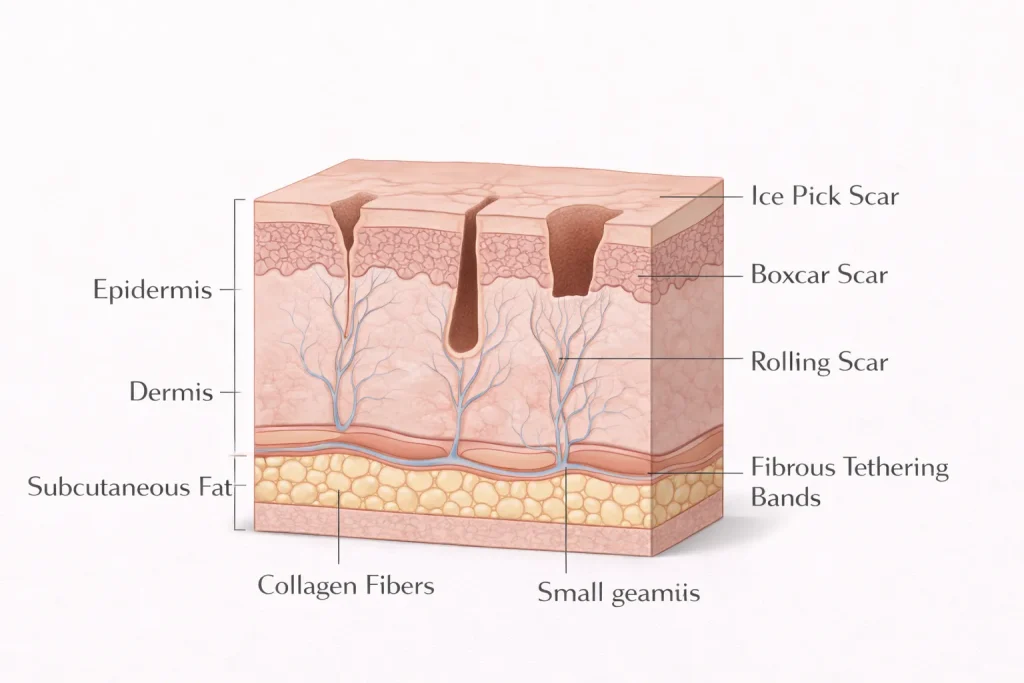
These are the most common type, resulting from a loss of collagen during the healing process. The skin cannot regenerate the tissue that was destroyed by the inflammation, causing a depression.
- Ice Pick Scars:
- Appearance: Deep, narrow, V-shaped punctures that look like enlarged pores. They extend deep into the dermis.
- Challenge: Because they are so deep, surface-level lasers often cannot reach the bottom of the scar. They are notoriously difficult to treat without specialized techniques.
- Boxcar Scars:
- Appearance: Round or oval depressions with steep, clearly defined vertical edges. They look like a “box” has been stamped into the skin.
- Challenge: Can be shallow or deep. Shallow ones respond well to resurfacing; deep ones require collagen stimulation.
- Rolling Scars:
- Appearance: Wide depressions with sloping edges that give the skin a wave-like or “undulating” texture.
- Challenge: These are often caused by fibrous bands of tissue (tethering) pulling the skin surface down into the subcutaneous fat.
2. Hypertrophic and Keloid Scars (Raised Scars)
These result from an overproduction of collagen. The body heals “too well,” creating a lump of tissue. They are more common on the jawline, chest, and back.
3. Post-Inflammatory Hyperpigmentation (PIH)
While technically not a “scar” (as there is no textural change), these dark brown or red marks are the ghost of acne past. In Dubai’s diverse population, PIH is extremely common in olive and darker skin tones (Fitzpatrick IV–VI).
Why Acne Scars Form: A Scientific Explanation
Why does one person get a pimple and heal perfectly, while another develops a deep crater? The answer lies in the intensity of inflammation and your body’s wound-healing response.
When a pore becomes clogged with oil and dead skin, bacteria (C. acnes) multiply, causing inflammation. If the follicle wall ruptures deep within the dermis, the infected material spills out, destroying the surrounding healthy tissue.
The body rushes to repair this breach.
- Inflammatory Phase: White blood cells attack the bacteria but also damage nearby tissue.
- Proliferative Phase: Fibroblasts produce collagen to fill the wound.
- Remodeling Phase: The collagen matures.
The Scarring Mechanism: If the body produces too little collagen, a depression forms (Atrophic scar). If the inflammation was prolonged or the cyst was squeezed (traumatizing the tissue further), the destruction of the dermal matrix is often too great for the body to repair smoothly. The “tethering” seen in rolling scars occurs when fibrous bands form between the skin and the muscle below, pulling the skin down permanently.
Treatment Options Explained in Depth
Modern dermatology clinic dubai protocols utilize technology to force the skin to remodel itself. Here are the gold-standard treatments available at Releva Clinic.
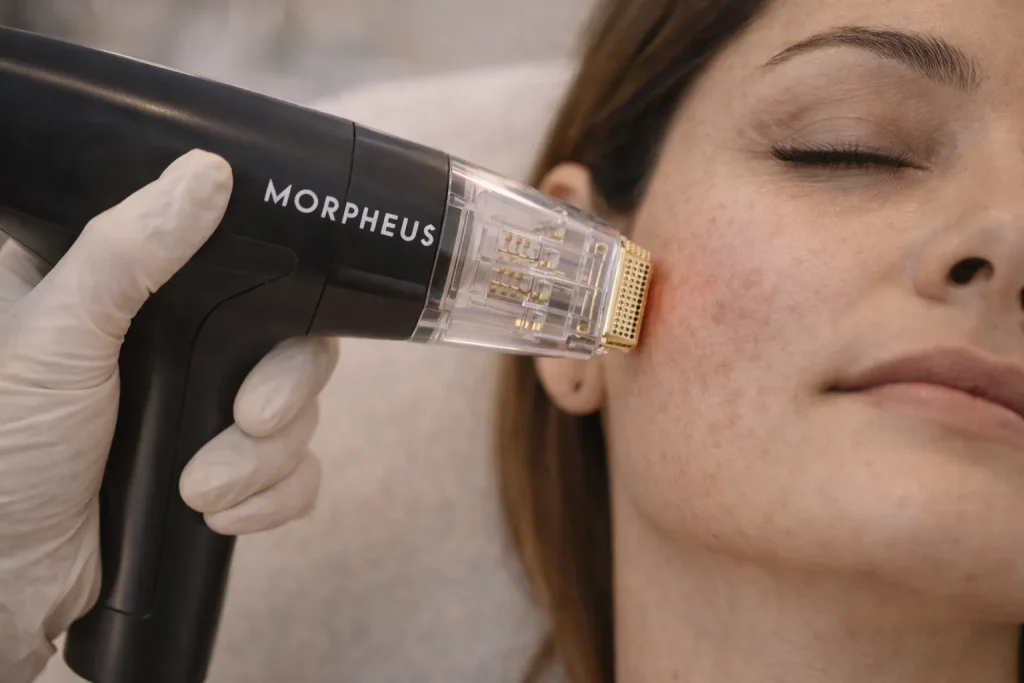
1. RF Microneedling (Morpheus8)
RF microneedling dubai has become the premier choice for treating mixed acne scars, particularly for darker skin tones where lasers carry higher risks.
- How It Works: The device (like Morpheus8) inserts gold-plated needles into the scar tissue at programmable depths (up to 4mm). Once inside, the tips emit Radiofrequency (RF) energy.
- The Mechanism:
- Mechanical Breakdown: The needles physically break up the tough scar tissue fibers.
- Thermal Remodeling: The heat causes existing collagen to contract and stimulates a massive production of new, healthy collagen and elastin.
- Why It Works for Scars: Unlike lasers that work from the top down, RF Microneedling works from the inside out. It rebuilds the foundation of the skin, plumping up the depressions of Boxcar and Rolling scars.
2. Microneedling with PRP (The “Vampire” Approach)
Microneedling PRP dubai combines mechanical stimulation with biological regeneration.
- How It Works: A medical-grade pen (like SkinPen) creates thousands of micro-channels. We then apply Platelet-Rich Plasma (PRP) derived from your own blood to the skin.
- The Mechanism: PRP is packed with Growth Factors (PDGF, TGF, VEGF). When applied to the micro-channels, these growth factors soak into the dermis and act as signaling molecules, instructing your stem cells to repair the tissue faster and more efficiently.
- Best For: Rolling scars, shallow boxcar scars, and overall skin texture improvement. It significantly speeds up healing compared to microneedling alone.
3. Laser Resurfacing (CO2 and Fractional)
Laser acne scar treatment dubai remains the heavy artillery for severe textural issues.
- CO2 Fractional Laser: This is an ablative laser. It vaporizes microscopic columns of tissue, essentially drilling tiny holes in the scar.
- The Mechanism: The body perceives this as an injury and rushes to fill the holes with brand new, baby-soft skin. It also shrinks the skin surface, pulling the edges of wide scars closer together.
- The Trade-off: It offers dramatic results but requires 5–7 days of downtime (redness, peeling). It must be used with extreme caution on darker skin to avoid hyperpigmentation.
- Non-Ablative Lasers (e.g., Fraxel): These heat the dermis without breaking the surface skin. They have less downtime but require more sessions.
4. Chemical Peels (TCA Cross & Phenol)
Chemical reconstruction of skin scars (CROSS) is a specialized technique for Ice Pick scars.
- TCA Cross: A high concentration of Trichloroacetic Acid (TCA) is applied only to the bottom of the deep ice pick scar using a toothpick-like instrument.
- The Mechanism: The acid causes a chemical burn inside the scar. As the wound heals, the bottom of the scar lifts up, becoming shallower.
- General Peels: Medium-depth peels can help smooth the edges of shallow boxcar scars and treat PIH (dark marks).
5. Subcision
This is a manual surgical technique often performed before energy treatments.
- How It Works: The dermatologist inserts a special needle (cannula) under the skin and sweeps it back and forth to cut the fibrous bands that are tethering rolling scars down.
- The Mechanism: Once the bands are cut, the skin “pops” back up. To prevent the bands from re-forming, we often inject a small amount of Dermal Filler into the space to act as a spacer.
Which Treatment Works Best for Each Scar Type?
No single device cures all scars. A tailored approach is key.
| Scar Type | Primary Recommended Treatment | Secondary/Adjunct Options | Why? |
|---|---|---|---|
| Ice Pick | TCA Cross | CO2 Laser, RF Microneedling | The scar is too deep for surface lasers alone; chemical reconstruction lifts the floor. |
| Rolling | Subcision + Filler | RF Microneedling, PRP | You must release the tethering bands first; otherwise, the skin cannot lift. |
| Boxcar (Shallow) | Microneedling / Laser | Chemical Peels | Resurfacing softens the sharp edges of the scar box. |
| Boxcar (Deep) | RF Microneedling | CO2 Laser | Deep heat is needed to build volume from the bottom up. |
| Hypertrophic | Steroid Injections | Pulsed Dye Laser | Need to flatten the excess collagen and reduce redness. |
| PIH (Dark Spots) | Chemical Peels / PRP | Pico Laser | Focus is on pigment removal, not texture. |
Results Timeline & Sessions Required
Patience is the most important ingredient in acne scar revision. We are rebuilding biological tissue, a process that takes months.
The Remodeling Cycle
- Month 1: Inflammation subsides.
- Month 3: New collagen begins to mature.
- Month 6: Structural changes become visible.
Typical Session Protocols
- Mild Scarring: 3–4 sessions of Microneedling PRP.
- Moderate Scarring: 3 sessions of RF Microneedling (Morpheus8) + 1 Laser Resurfacing.
- Severe Scarring: 6+ sessions combining Subcision, TCA Cross, and Energy Devices over a 12-month period.
Note: Improvement is usually measured in percentages. A realistic goal is a 50% to 80% improvement in texture. Achieving “glass skin” (100% removal) is medically difficult for deep scarring, though significant camouflage is possible.
Safety, Skin Type & Medical Assessment
Dubai is home to a diverse population with a high prevalence of Fitzpatrick Skin Types III, IV, and V (Middle Eastern, Asian, and Mediterranean skin).
The Risk of Hyperpigmentation
Darker skin tones have more active melanocytes. If you use an aggressive laser (like fully ablative CO2) on dark skin, the heat can trigger Post-Inflammatory Hyperpigmentation (PIH), leaving dark brown squares on the face that last for months.
The “Color-Blind” Advantage of RF
This is why RF Microneedling (Morpheus8) is so popular in Dubai. The needles are insulated, meaning they deliver heat only at the tip (deep in the dermis), bypassing the melanin-rich surface layer. This makes it significantly safer for darker skin tones compared to lasers that must travel through the surface.
Medical Assessment
Before any treatment, a Dermatologist must assess:
- Active Acne: You cannot treat scars if you still have active breakouts. The inflammation will ruin the results. We must cure the acne first.
- Scar Type: Diagnosing whether scars are rolling or tethered changes the plan entirely.
- Healing History: Do you form keloids? If so, microneedling requires special caution.
Why Professional Dermatology Treatment Matters
In the age of Instagram, many spas and beauty salons offer “microneedling” or “scar facials.” It is crucial to understand the difference between a cosmetic service and a medical procedure.
- Depth: Salon devices are usually limited to 0.5mm depth. This treats the epidermis only (glow). Acne scars live in the dermis (1.5mm – 3.0mm). Only a medical device used by a doctor or licensed nurse can reach these depths.
- Sterility: Microneedling involves breaking the skin barrier with blood exposure. Medical clinics adhere to hospital-grade sterilization to prevent HIV or Hepatitis transmission.
- Complication Management: If a laser causes a burn or a reaction, a Dermatologist can prescribe corticosteroids or antibiotics immediately. A salon cannot.
Why Releva Clinic Is Trusted for Acne Scar Treatment in Dubai
Acne scarring is one of the most complex conditions to treat in aesthetic dermatology. At Releva Clinic, we approach it with a combination of empathy and unparalleled technical skill.
1. Diagnostic Precision We don’t just sell packages. We start with a VISIA skin analysis and physical exam to map your scars. We identify which are ice pick, which are rolling, and which are pigment-based.
2. The Releva “Hybrid” Protocol We rarely use one machine. Our protocols are famous for being multi-modal. A single session might include:
- Subcision for rolling scars.
- Morpheus8 for deep remodeling.
- Topical Exosomes to speed up healing by 50%. This “stacking” of treatments delivers faster results than doing them individually.
3. Latest Technology We utilize FDA-approved, industry-leading devices like InMode Morpheus8 and the SkinPen Precision. We do not use generic imitations.
4. Holistic Dermatology We treat the patient, not just the scars. If you have hormonal imbalances causing breakouts, our dermatologists address the root cause to ensure your investment in scar treatment is protected from future acne.
Frequently Asked Questions (FAQ)
1. Can acne scars be removed completely? “Removed” is a strong word. “Improved significantly” is more accurate. With a comprehensive plan, we can often reduce the visibility of scars by 70–80%, making them unnoticeable in normal social interactions, even if the texture isn’t 100% like virgin skin.
2. Is RF Microneedling better than Laser for acne scars? For deep scars and darker skin types, yes. RF Microneedling penetrates deeper and carries less risk of pigmentation. For superficial texture and lighter skin, Laser might be superior. Often, we use both.
3. Does the treatment hurt? Treating scar tissue requires energy and depth, so there is sensation. However, at Releva Clinic, we use a triple-anesthetic protocol: high-strength topical numbing cream (BLT), nerve blocks (injections to numb the face), and chilled air (Zimmer cooler). Most patients rate pain a 3 or 4 out of 10.
4. How much downtime is needed?
- Microneedling PRP: 1–2 days of redness (like a sunburn).
- Morpheus8: 3–4 days of redness and micro-crusting.
- CO2 Laser: 5–7 days of peeling and redness.
- Subcision: Bruising for 7–10 days (can be covered with makeup).
5. How much does acne scar treatment cost in Dubai? Costs vary by complexity. A single microneedling session might start at AED 1,000, while a comprehensive Morpheus8 or Laser session ranges from AED 2,500 to AED 4,000. We create customized packages to make full courses more affordable.
6. Can I treat scars while I still have acne? Generally, no. We must stabilize the active inflammation first, often using medications or chemical peels. Treating active cysts with microneedling spreads bacteria. However, we can treat the redness (PIE) while clearing the acne.
7. Why do my scars look worse as I get older? Aging involves the loss of collagen and facial fat. As the “cushion” under the skin deflates, the skin becomes looser, making the depressions of old acne scars look deeper and more pronounced.
8. Are home microneedling rollers effective? No, and they are dangerous. Home rollers (0.2mm) do not reach the deep dermis where scars live. Furthermore, the needles often bend, tearing the skin (causing “track mark” scars) and introducing bacteria. Leave needles to the professionals.
9. What are Exosomes? Exosomes are the newest breakthrough in scar therapy. They are signaling molecules derived from stem cells containing growth factors and mRNA. Applying them after laser/needling reduces downtime by half and significantly boosts the collagen response compared to PRP.
10. Can fillers help acne scars? Yes. For broad rolling or boxcar scars, injecting a small amount of Hyaluronic Acid filler (like Restylane or Juvederm) under the scar can lift it instantly. This is a temporary fix (lasts 6–12 months) often done for immediate results before events.
11. Is Subcision permanent? Yes. Once the tethering band is cut, it generally does not reconnect, especially if a spacer (filler) is used. The elevation of the scar is permanent.
12. Can I go in the sun after treatment? Absolutely not. UV radiation causes inflammation and will turn your healing scars dark brown (hyperpigmentation). You must strict avoid sun and wear SPF 50+ for at least 2 weeks post-procedure.
Reclaim Your Confidence
Acne scars tell a story of a past battle, but they don’t have to define your future. With the advanced medical interventions available at Releva Clinic, smooth, healthy skin is an achievable reality.
You don’t have to hide behind filters anymore.
Take the first step toward skin freedom. Book a specialized scar assessment with our Dermatologists today and let us build a plan to restore your skin’s surface and your self-esteem.