


Profhilo is a specific injectable hyaluronic-acid product. “Skin booster” is a broader, inconsistently defined category that can include different injectable formulations and, in some publications, device-assisted treatments. A clinic may market Profhilo separately from its skin-booster menu, but that is a service-category distinction—not proof that the products work in completely unrelated ways.
What matters most is the exact product, its approved use in the relevant jurisdiction, the treatment goal, the quality of evidence, and the clinician’s assessment of your skin.
Quick answer: Profhilo is a branded injectable based on hybrid cooperative complexes of high- and low-molecular-weight hyaluronic acid. The term skin booster covers a wider group of products and approaches intended to improve aspects of skin quality, such as hydration and texture. Both categories may be discussed for skin-quality concerns, but neither is automatically superior or a substitute for every other aesthetic treatment. Ask which product is being offered, why it suits your concern, how the plan is priced, and what outcomes are realistically supported.
Profhilo vs skin boosters at a glance
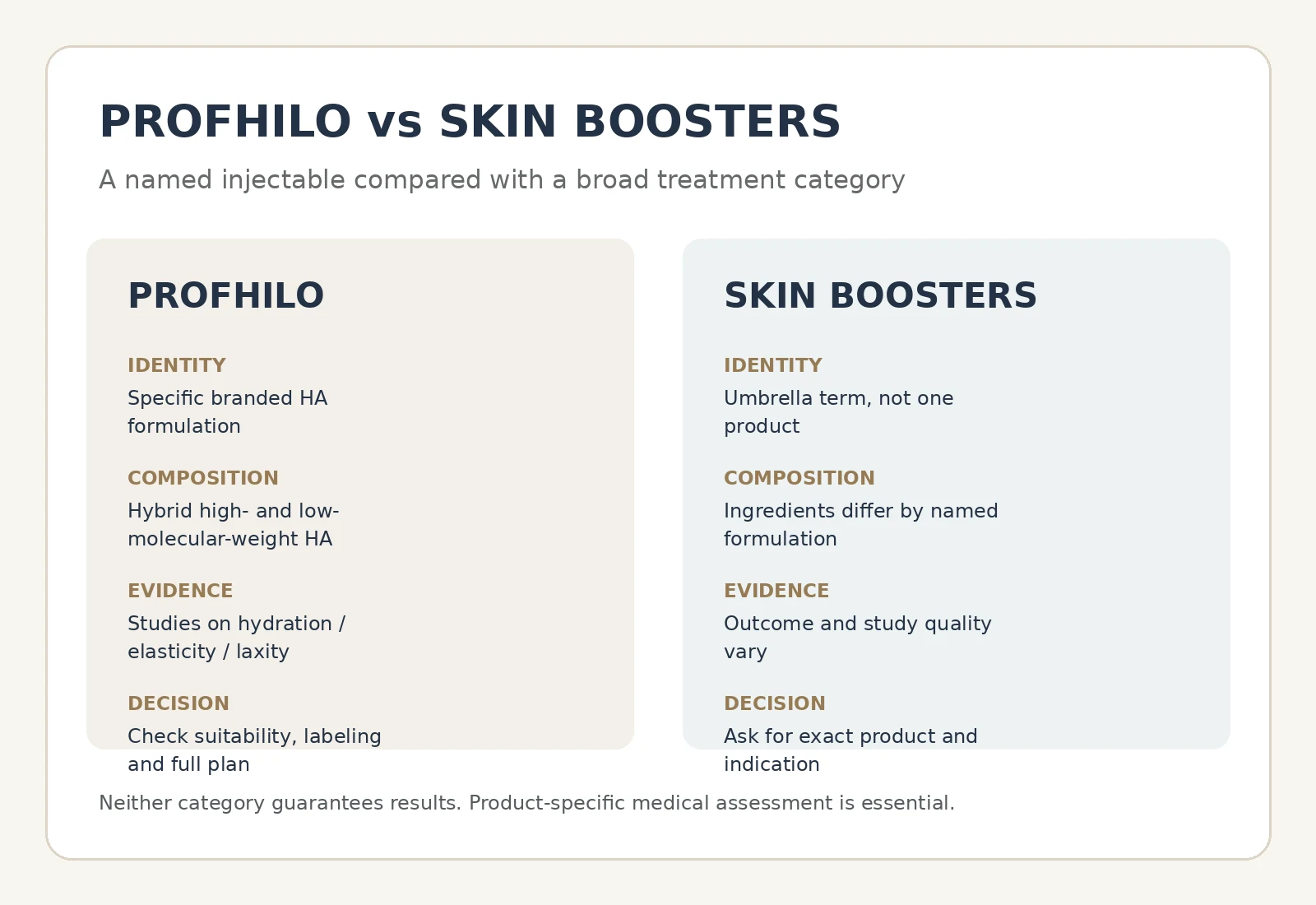
| Question | Profhilo | Skin boosters |
|---|---|---|
| What is it? | A particular branded hyaluronic-acid injectable product | A broad treatment category, not one uniform product |
| Main formulation | Hybrid cooperative complexes of high- and low-molecular-weight hyaluronic acid | Depends on product: may include HA-based injectables and other formulations or approaches |
| Main treatment conversation | Skin quality, hydration, elasticity and skin laxity where supported by the specific product/evidence | Product-specific skin-quality goals, which may include hydration, texture, and related concerns |
| Does it replace traditional volume filler? | Not automatically; its role and product labeling differ from a volumizing filler | Not automatically; some products may have different indications and physical properties |
| Is one always better for wrinkles? | No | No |
| Is the number of sessions the same? | Follow the actual product’s instructions and individualized plan | There is no single skin-booster protocol |
| Can results be guaranteed? | No | No |
| How to compare price? | Confirm the precise formulation, amount, number of sessions and follow-up | First identify the exact product, then compare like-for-like plans |
The table is a starting point, not an individual treatment recommendation. A meaningful comparison requires named products rather than a brand on one side and an undefined category on the other.
First, what is Profhilo?

Profhilo is a branded injectable containing hybrid cooperative complexes of high- and low-molecular-weight hyaluronic acid. Hyaluronic acid is a substance naturally present in the body; different aesthetic products use it in different ways. A familiar HA dermal filler is commonly selected when the aim is to add or restore structural volume. Profhilo is generally discussed in a different skin-quality context.
Its manufacturer describes a process involving combined forms of HA. But the words bio-remodelling or bioremodelling should not be treated as a guaranteed clinical outcome. The relevant question is what human studies have actually measured: hydration, elasticity, skin laxity, texture, density or other endpoints.
A 2026 systematic review identified nine studies involving 278 participants examining Profhilo and Profhilo Body. The authors reported improvements or trends across several skin-quality measures. Those findings are encouraging, but the included studies were not all large, blinded, head-to-head trials. Some authors were affiliated with the product manufacturer. Those factors should temper claims of certainty, especially when comparing Profhilo with unrelated products. [1]
Is Profhilo a dermal filler?
That depends on how the question is being used. Both Profhilo and many traditional dermal fillers are injectable HA-based products, but their formulations, intended roles and clinical uses should not be conflated. A product used with a skin-quality objective should not be promoted as equivalent to the structural shaping you might expect from a volumizing filler.
If your principal concern is deep volume loss or facial contour, ask the clinician whether Profhilo is even the right type of intervention to discuss. A skin-quality treatment and a volume-restoration treatment are not the same purchase.
What are skin boosters?
Skin booster is an umbrella term. That is one reason online comparisons can be misleading. A patient may hear the phrase used for injectable HA products, combinations of HA with additional ingredients, polynucleotide-based products or other approaches. These are not interchangeable formulations, and they do not share a universal safety profile or evidence base.
A 2026 narrative review in the Journal of Cosmetic Dermatology described considerable heterogeneity in how skin boosters are defined, delivered and studied. It proposed a practical classification while noting that clinical outcomes and limitations depend on the product and treatment method. [2]
This means “skin booster” alone is not enough information to assess likely benefits, risk, price, or suitability.
The single most useful question to ask
“Which exact skin-booster product would you use for me—and why?”
A transparent answer should identify the product and its ingredients, proposed treatment area, relevant labeling, expected type of improvement, known side effects, number of planned sessions, total price and follow-up arrangements.
Is Profhilo better than skin boosters for hydration?
There is no responsible universal answer because the comparison class is too broad. Profhilo has published evidence on hydration and some other skin-quality endpoints, including the 2026 review discussed above. Various skin-booster formulations also have published studies, but their formulations, study populations and outcome measures differ. [1,2]
An important distinction is improved skin hydration versus a visibly transformed face. A study may find a difference in a hydration instrument score without establishing that every patient will notice a dramatic cosmetic change.
Before booking, consider whether your actual concern is skin dryness, dullness, superficial texture, deeper folds, pigment variation, or loss of volume. Those are not one problem, and injectable HA is not automatically an answer to all of them.
What about elasticity, fine lines and skin laxity?
The evidence is more nuanced than marketing labels suggest. Several studies of Profhilo have explored skin elasticity, density, laxity and wrinkles, with mixed endpoints and varying methods. The 2026 systematic review reported positive changes or trends in a number of these measures but does not prove that Profhilo outperforms every named skin booster. [1]
Other skin-booster studies may focus on different endpoints—for example, hydration or surface texture. A statement such as “Profhilo is for tightening while boosters only hydrate” simplifies away the fact that ingredients, delivery and research design vary.
If laxity is substantial, or if your concern is sagging that would ordinarily require another type of treatment, a clinician should explain what a skin-quality injectable cannot achieve.
A useful way to frame expectations
Ask the clinic to describe the proposed result using a clear, modest endpoint: some improvement in hydration, potentially smoother-looking texture, or a change in measured skin elasticity where the evidence supports it.
Be cautious if a consultation jumps directly from “hyaluronic acid” to a promise of lifting, facelift-like change, guaranteed collagen production or permanent rejuvenation. Those are stronger claims and require stronger evidence.
Profhilo vs skin boosters: how do the treatment plans differ?
The number of appointments cannot be answered fairly without naming the product and reviewing its actual instructions. Some manufacturers describe multi-session courses and assessment intervals. Other products use different schedules. The brand name or category alone does not justify an identical protocol for every patient.
The plan may depend on:
- the precise formulation and its current product instructions;
- the intended anatomical area;
- previous cosmetic treatments;
- skin characteristics and the concern being assessed;
- relevant health history;
- clinician judgment and local regulatory requirements.
This article deliberately does not prescribe injection depths, locations, doses or a “recommended course.” Such details belong in a qualified clinical assessment and the specific product documentation.
Which looks more natural?
“Natural-looking” is a preference, not a product specification.
Some people want their skin to feel less dry or look less crepey while preserving their facial features. Others want to restore lost volume. A skin-quality injectable and a structural filler answer different treatment questions, even though both may be made with HA.
A result also depends on the individual starting point, the product, the treatment plan and the way the outcome is evaluated. Neither Profhilo nor the entire skin-booster category can guarantee an invisible, subtle or universally pleasing result.
How long do results last?
There is no single duration that accurately covers Profhilo and every skin-booster product. Studies assess different follow-up periods and outcomes. Some measurements may improve before other visible changes are noticed; some effects may diminish over time.
Ask for product-specific evidence and the clinic’s recommended follow-up period rather than relying on a fixed “lasts six months” slogan. Maintenance schedules should be justified by your needs, the product instructions and an updated assessment, not just by a prepaid package.
Are Profhilo and skin boosters safe?
These are injectable aesthetic treatments and require careful selection, sterile technique, informed consent and professional oversight. “Minimally invasive” does not mean risk-free.
Possible short-term reactions associated with injectable HA procedures include tenderness, redness, swelling, bruising and localized bumps. Published Profhilo studies have described mostly temporary local reactions, but small studies cannot exclude every rare complication. [1]
For dermal fillers and other products falling within that regulatory category, the U.S. FDA explains that accidental injection into a blood vessel can cause serious harm, including tissue necrosis, vision abnormalities or blindness, and stroke. Product-specific risk and classification matter: it would be misleading to assign every filler warning identically to every treatment marketed as a skin booster, or to claim that a named product has no vascular risk without adequate evidence. [3]
A good consultation should cover what to do if unusual pain, blanching, vision symptoms, severe reactions, or other concerning changes occur after any injectable treatment. Sudden visual changes or severe neurological symptoms require emergency medical care.
Who should seek individual medical advice before any injectable treatment?
Anyone considering treatment should discuss allergies, prior reactions, active skin conditions or infections in the intended treatment area, pregnancy or breastfeeding, relevant medical diagnoses, prescription and nonprescription medicines, and previous cosmetic procedures with the treating professional. This is not a list of universal contraindications: suitability and restrictions are product- and patient-specific.
Can Profhilo and other skin boosters be combined?
A clinic might discuss multiple products for different goals, but combining or layering treatments is not automatically more effective. Evidence for each product individually does not establish that a combination has been tested, is safer, or will give better results.
If a combined plan is suggested, ask what additional benefit is expected from each step, whether that benefit has supporting clinical evidence, and what the combined cost and risk are.
Profhilo vs skin boosters in Dubai: which costs more?
Comparing a named brand with an undefined category is a poor basis for pricing. A quote for Profhilo may be per treatment, while an advertised skin-booster price may refer to a different product, amount, anatomical area or package.
A meaningful quotation should answer five questions:
- What exact product and formulation are included?
- What is the treatment scope? Which area is being assessed?
- What is the total proposed course price, not just the first appointment price?
- Are consultation, follow-up and potential additional sessions included?
- What will be payable if the plan changes after assessment?
For the broader market and per-session pricing context, use Releva Clinic’s separate article Profhilo Price in Dubai: Cost per Session, Treatment Course & What Changes the Price if that article is already live. This comparison page intentionally does not publish a market price table or attribute an unverified tariff to Releva Clinic.
What should you ask before choosing a clinic in Dubai?

Patients do not need to know every ingredient before visiting a clinic. But they should leave the consultation understanding which product is proposed, what goal it serves and what it does not promise.
Use these questions:
- What is the exact product name, manufacturer and formulation?
- Is the product appropriately authorized for the proposed use in the UAE, and is this use within its labeling?
- What aspect of my skin are we trying to improve, and how will we assess the outcome?
- What clinical evidence supports the proposed product for that outcome?
- How does this plan differ from a traditional volume filler or another treatment?
- What side effects and rare complications should I understand?
- Who will perform the procedure, and what are their verified credentials and scope?
- How many appointments are included, and what is the total price?
- What happens if I choose not to proceed after the assessment?
These questions are more revealing than asking which brand is “best.”
Profhilo and skin-booster consultations at Releva Clinic
Releva Clinic is a multi-specialty polyclinic located at Villa 1144, Al Wasl Road, Umm Suqeim 2, Dubai. Its current canonical service information lists Profhilo as a named product and Skin Boosters in the Face & Injectables service ecosystem.
However, the registry used to prepare this article does not establish the full, currently available skin-booster product lineup, a fixed Profhilo price, a standard treatment package, or the identity of a specific injector for these services. For current availability, product information, practitioner details and a clinic-specific quotation, contact the team directly.
Ask Releva Clinic about a skin-quality consultation on WhatsApp
Reception: +971 4 329 4666
Location: Villa 1144, Al Wasl Road, Umm Suqeim 2, Dubai, UAE.
A consultation should begin by understanding the concern—not by treating a branded product as an automatic recommendation.
The bottom line: which one should you choose?
Profhilo is a defined hyaluronic-acid product; skin boosters are a broad family of products and methods. Profhilo has published evidence on selected skin-quality outcomes, while the evidence behind products marketed as skin boosters varies widely. There is no strong scientific basis for stating that Profhilo is universally better than all skin boosters or that every booster works in the same way.
A good next step is to identify your concern, ask for the exact proposed product, understand realistic outcomes and risks, and request a transparent, complete quotation.
Frequently asked questions
Is Profhilo a skin booster?
Profhilo is a specific injectable HA product commonly marketed separately under a skin-remodelling or skin-quality category. In everyday clinic language it may be compared with skin boosters, but “skin booster” itself is an imprecise umbrella term. The precise formulation matters more than the label.
What is the main difference between Profhilo and skin boosters?
Profhilo is a named formulation based on hybrid cooperative complexes of HA. Skin boosters may refer to multiple different products and techniques. It is not a comparison between two single, standardized products.
Is Profhilo better for skin laxity?
Some studies have explored improvements in skin elasticity and laxity after Profhilo, but the current evidence does not establish universal superiority over every other skin booster or suitability for significant sagging. [1]
Will either treatment add facial volume?
They should not be assumed to work like traditional structural fillers. The expected effect depends on the exact product and the treatment plan. If facial volume loss is the priority, discuss that explicitly during assessment.
Are results immediate?
Local swelling can be noticeable shortly after injection, but a meaningful skin-quality outcome should not be judged from early post-treatment swelling. Timelines vary by product and the outcome being measured.
How many sessions are needed?
There is no universal skin-booster course. Follow the exact product instructions and an individualized clinical plan, rather than a fixed package advertised for every patient.
Are there risks?
Yes. Local reactions can include swelling, bruising, redness and tenderness. Product-specific risks and rare serious complications should be reviewed with a licensed treating professional. “No downtime” and “risk-free” are not responsible guarantees.
Can I have Profhilo and another skin booster together?
Combination plans may be discussed in clinical practice, but evidence for individual products is not proof that the combination is necessary or superior. Discuss the rationale, safety and cost for each component.
How much is Profhilo at Releva Clinic?
A verified, current Releva-specific Profhilo tariff was not available in the clinic’s canonical facts at the time this guide was prepared. Contact reception or WhatsApp for a current, individualized quotation.
Does Releva Clinic offer skin boosters?
Skin Boosters and Profhilo are both listed within Releva’s current service ecosystem. The precise product selection and appointment availability should be confirmed with the clinic.
Sources and further reading
- Sparavigna A, et al. A Systematic Review of the Efficacy and Safety of Profhilo® and Profhilo® Body. Plastic and Aesthetic Nursing (2026). PubMed: 41920062. Nine studies, 278 participants; note limited and heterogeneous evidence and manufacturer-linked authorship.
- Yi et al. Skin Boosters: 2026 Updated. Journal of Cosmetic Dermatology (2026). Full review. Narrative review noting broad definitions and heterogeneous evidence.
- U.S. Food and Drug Administration. Dermal Fillers (Soft Tissue Fillers). Official FDA guidance. Relevant to product categories classified as fillers; do not generalize every point to every booster.
- Dubai Health Authority. Standards for Medical Advertisement Content on Social Media, circular 17 August 2026. Official DHA circular.
Medical information notice: This guide is educational and does not provide an individual diagnosis, prescribe an injectable treatment or guarantee results. Product authorization and professional scope must be verified for the relevant jurisdiction. Final medical review by Releva Clinic is required before publication.