


Struggling with Melasma or uneven skin tone in Dubai? Explore expert pigmentation treatments, from Pico Lasers to Chemical Peels. Learn the science of prevention at Releva Clinic.
In the sun-drenched landscape of the UAE, light is often seen as a symbol of luxury and vitality. Yet, for our skin, this abundance of light specifically Ultraviolet (UV) radiation is a double-edged sword. While it provides Vitamin D, it is also the primary architect of one of the most stubborn and distressing skin conditions: Hyperpigmentation.
Walk through any mall in Dubai, and you will see a flawless dedication to aesthetics. However, look closely, and you will notice that uneven skin tone is a pervasive concern. Whether it is the distinct “mask” of melasma across the cheeks or the scattered “confetti” of sunspots on the hands and forehead, pigmentation issues affect men and women of every age and skin type.
The search for an effective pigmentation treatment dubai is often fraught with frustration. Many patients come to Releva Clinic after spending thousands of dirhams on “brightening” creams that deliver little to no results. This is because pigmentation is not a surface-level dirt to be scrubbed away; it is a complex biological process occurring deep within the cellular machinery of the skin.
This authoritative, guide strips away the marketing fluff to present the medical reality of pigmentation. We will explore the biology of melanin, why the Dubai climate poses unique challenges, and the evidence-based treatments from lasers to tranexamic acid that actually restore clarity to your complexion.
What Is Pigmentation? The Biology of Color
To treat pigmentation, we must first understand the mechanism behind it: Melanogenesis.
The Architect: The Melanocyte
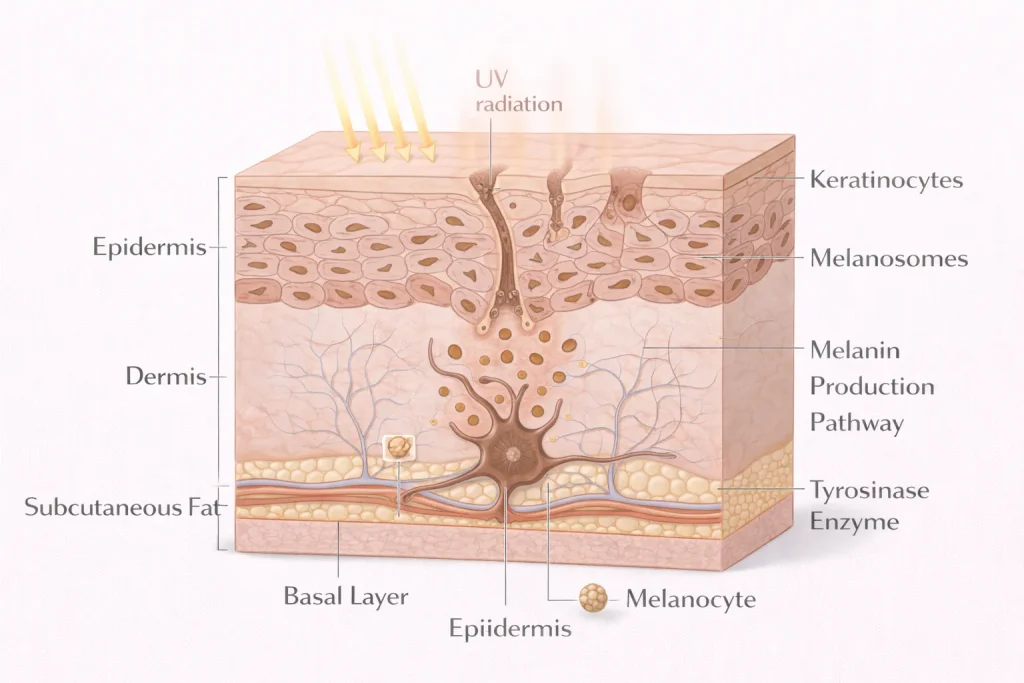
Deep in the basal layer of your epidermis (the bottom of the top layer of skin) sit octopus-shaped cells called melanocytes. Their job is to produce pigment (melanin) and package it into tiny bundles called melanosomes, which are then transported to the surrounding skin cells (keratinocytes).
In a healthy state, melanin is your body’s natural umbrella. When UV rays hit the skin, melanocytes produce melanin to shield the DNA of your skin cells from radiation damage. This is what we call a tan.
The Malfunction: Hyperpigmentation
Hyperpigmentation occurs when these melanocytes become hyperactive or damaged. Instead of producing an even wash of color, they dump excessive amounts of melanin into specific areas, or the pigment “leaks” down into the deeper dermis (making it harder to treat).
The Trigger Enzyme: Tyrosinase
The key player in this process is an enzyme called Tyrosinase. It is the catalyst that turns the amino acid Tyrosine into Melanin. Almost all effective medical brightening agents (like Hydroquinone or Vitamin C) work by inhibiting this enzyme—essentially putting a padlock on the factory door.
The Dubai Factor
In Dubai, the UV Index regularly exceeds 11 (Extreme). This creates a constant, low-grade stimulation of tyrosinase. Even walking to your car or sitting near a window is enough to trigger pigment production in predisposed individuals. Furthermore, the intense heat (Infrared radiation) can stimulate pigmentation even without direct sun exposure—a crucial factor often overlooked in treatment plans.
Types of Pigmentation: Diagnosis is Key
Treating all dark spots the same is a recipe for failure. A laser that removes a sunspot can make melasma permanently worse. Accurate diagnosis by a dermatologist is the first step.
1. Melasma (The “Mask of Pregnancy”)
Melasma is the most complex and difficult type to treat.
- Appearance: Symmetrical, blotchy, brown or greyish patches on the forehead, cheeks, bridge of the nose, and upper lip.
- Causes: It is a hormonal-vascular-pigmentary condition.
- Hormones: Triggered by Estrogen and Progesterone (pregnancy, birth control pills, HRT).
- Vascular: Underlying dilated blood vessels feed the melanocytes.
- Heat: Highly sensitive to heat (saunas, hot yoga, cooking over a hot stove).
- The Challenge: It is chronic. There is no “cure,” only management. Aggressive lasers can inflame melasma, causing it to rebound darker.
2. Solar Lentigines (Sunspots / Liver Spots)
These are direct evidence of UV damage.
- Appearance: Distinct, flat, oval spots that look like large freckles. Commonly found on the face, hands, and décolletage.
- Causes: Cumulative sun exposure over years. As we age, the skin loses its ability to distribute melanin evenly, leading to these clumps.
- The Challenge: They are usually epidermal (surface-level) and easier to treat than melasma.
3. Post-Inflammatory Hyperpigmentation (PIH)
This is the “ghost” of a past injury.
- Appearance: Flat dark spots (brown, grey, or black) left behind after acne, a burn, an insect bite, or eczema.
- Causes: Inflammation triggers melanocytes to release pigment as a defense mechanism. It is extremely common in darker skin types (Fitzpatrick IV–VI).
- The Challenge: If treated aggressively, it can worsen. Patience and gentle exfoliation are key.
4. Freckles (Ephelides)
- Appearance: Tiny, tan/red spots that appear in childhood.
- Causes: Genetic. They darken in summer and fade in winter.
- The Challenge: Generally harmless and aesthetic preference determines treatment.
Treatment Options: The Medical Arsenal
At Releva Clinic, we employ a “Ladder of Treatment,” starting with the least invasive and moving to advanced energy devices. Often, a combination is required.
1. Topical Prescription Agents (The First Line of Defense)
Before touching a laser, we must suppress the melanocytes.
- Hydroquinone: The gold standard. It is a potent tyrosinase inhibitor. Used for short periods (3–4 months) under medical supervision to bleach pigment.
- Tranexamic Acid: Originally a drug to stop bleeding, it was found to effectively treat melasma by reducing the vascular component and inflammation. It can be taken orally (pill) or applied topically.
- Cysteamine: A newer, non-hydroquinone alternative naturally present in human cells. It is highly effective for resistant melasma.
- Retinoids (Tretinoin): Increases cell turnover, pushing pigmented cells up and out of the skin faster.
2. Chemical Peels
Peels remove the pigmented surface layers while infusing ingredients deep into the skin.
- Cosmelan / Dermamelan: The world’s leading depigmentation peel for melasma. It is a two-step process: a thick mask applied in-clinic (left on for 8–10 hours) followed by a strict home-care regime. It inhibits tyrosinase while peeling the skin.
- TCA Peels: Trichloroacetic acid is excellent for sunspots and deeper textural issues but requires downtime (peeling for 5–7 days).
- Glycolic/Lactic Acid Peels: Gentler options for mild PIH and brightening (“Lunchtime Peels”).
3. Laser & Light Therapies
Choosing the right laser is critical.
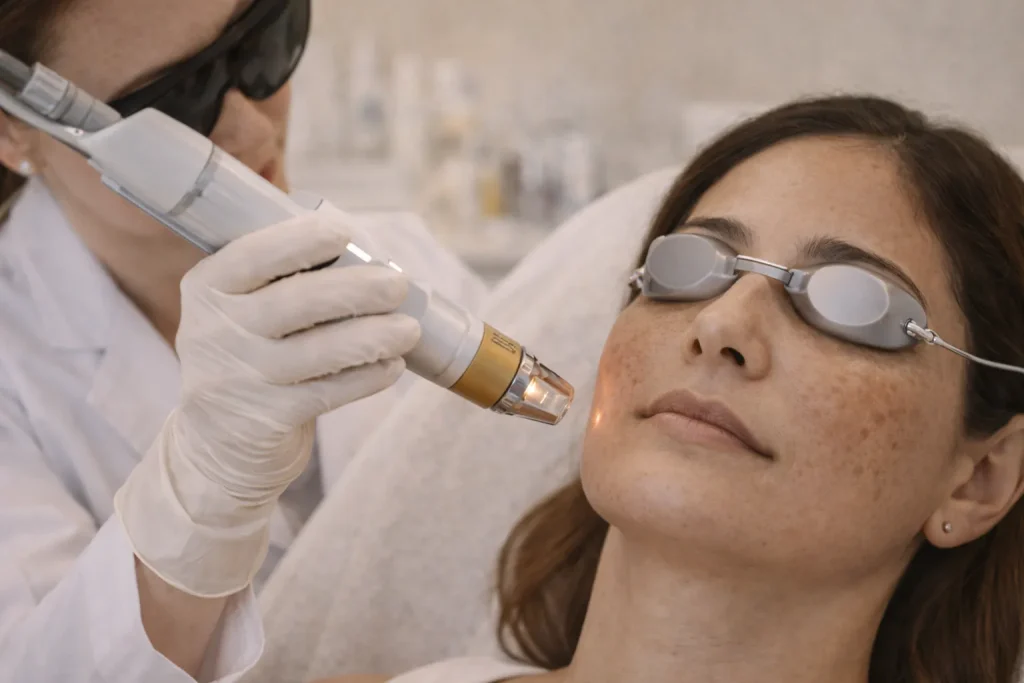
- Pico Lasers: The modern standard. Unlike older lasers that use heat (photothermal), Pico lasers use sound waves (photoacoustic). They shatter the pigment into dust-like particles that the body’s immune system clears away. Because they use less heat, they are safer for Melasma and darker skin tones.
- IPL (Lumecca): Intense Pulsed Light is fantastic for distinct sunspots and redness on fair to medium skin. It “zaps” the superficial pigment, which turns dark like coffee grounds and flakes off after a week. Note: Generally avoided for Melasma.
- Q-Switched Nd:YAG: The workhorse for deep pigment and stubborn birthmarks.
4. RF Microneedling (Morpheus8)
While primarily a tightening device, Morpheus8 is excellent for PIH and stubborn pigmentation in darker skin.
- Why: By remodeling the dermis, it strengthens the basement membrane (the barrier between the upper and lower skin). A weak basement membrane allows pigment to “drop” down; strengthening it prevents this.
- Safety: It uses color-blind energy, making it safe for all skin tones.
5. Mesotherapy & Skin Boosters
Injecting cocktails of Glutathione, Vitamin C, and Tranexamic Acid directly into the mesoderm (middle skin layer) bypasses the skin barrier for targeted brightening.
Prevention Strategies: The “Swiss Cheese” Model
Treatment without prevention is a waste of money. In Dubai, sun protection must be multi-layered, like slices of Swiss cheese—one layer has holes, but stack enough layers, and you get solid protection.
1. Broad-Spectrum SPF 50+
- The Rule: Apply 2mg per cm² (two finger lengths) to the face and neck every morning.
- Reapplication: Every 2 hours if outdoors. If wearing makeup, use an SPF mist or powder.
- The Type: Mineral sunscreens (Zinc/Titanium) are often better for Melasma as they reflect heat, whereas chemical sunscreens absorb heat.
2. Antioxidants (Vitamin C)
Sunscreen only blocks about 95% of UV rays. Antioxidants neutralize the free radicals generated by the remaining 5%. A high-quality Vitamin C serum (L-Ascorbic Acid) is your safety net.
3. Physical Shields
- Hats with wide brims (baseball caps do not protect the cheeks).
- UV-rated sunglasses (protects the delicate eye area).
- Car window tinting: Standard glass blocks UVB but lets UVA (the aging/pigment ray) through. Ensure your car tint has high UVA protection.
4. Thermal Management (For Melasma)
If you have Melasma, heat is your enemy.
- Avoid saunas and steam rooms.
- After a heavy workout, wash your face with cool water immediately to bring the skin temperature down.
- Be careful when opening a hot oven.
5. Hormonal Management
If your pigmentation is linked to the contraceptive pill, discuss non-hormonal alternatives (like the Copper IUD) with your gynecologist.
Why DIY Treatments Often Fail (and Cause Damage)
The internet is flooded with home remedies for skin brightening treatment dubai. Here is why you should avoid them.
- Lemon Juice: Highly acidic and phototoxic. If you apply lemon juice and go into the sun, it causes a severe chemical burn called Phytophotodermatitis, leaving behind dark hyperpigmentation that can last for years.
- Baking Soda/Scrubs: Physical scrubbing inflames the skin. Inflammation triggers melanocytes. Scrubbing a dark spot often makes it darker (PIH).
- Unstable Serums: Vitamin C oxidizes rapidly. If your serum has turned brown/orange, it is useless and potentially pro-oxidative (causing damage). Medical-grade skincare ensures stability and absorption.
Why Choose Releva Clinic for Pigmentation Treatment
Pigmentation is notoriously tricky. One wrong setting on a laser can turn a treatable sunspot into permanent white scarring (hypopigmentation) or rebound hyperpigmentation.
At Releva Clinic, we prioritize safety and science.
1. The VISIA Diagnosis We don’t guess; we see. Our VISIA skin analysis system uses UV photography to show us the pigment under the skin that hasn’t surfaced yet. This allows us to treat future spots before they appear.
2. Customized Protocols We rarely use a “cookie-cutter” approach. A typical Melasma protocol might include:
- Oral Tranexamic Acid (prescribed by our Dermatologist).
- A course of gentle Pico Laser toning.
- A customized home-care regime with medical-grade tyrosinase inhibitors.
3. Expertise in Diverse Skin Tones Dubai is a global hub. Treating Asian, African, and Middle Eastern skin requires different parameters than treating Caucasian skin. Our specialists are experts in ethnic dermatology, knowing exactly how to treat pigment without causing burns or PIH.
Frequently Asked Questions (FAQ)
1. Can Melasma be cured permanently? Technically, no. Melasma is a chronic condition, similar to diabetes or high blood pressure. It can be cleared and controlled, but if you stop maintenance or go into the sun unprotected, it will return. Maintenance is a lifetime commitment.
2. Is Laser safe for dark skin? Yes, but only specific lasers. Pico lasers and Nd:YAG lasers are safe for darker skin because they bypass the surface melanin. IPL is generally risky for dark skin (Fitzpatrick IV–VI) as it can cause burns.
3. How long does it take to see results? Pigment is stubborn.
- Sunspots: 1–2 weeks after IPL/Laser (they flake off).
- Melasma: 3–6 months of consistent treatment.
- PIH (Acne marks): 2–4 months.
4. Does the Cosmelan peel hurt? The application is painless. However, the recovery involves significant peeling, redness, and tightness for roughly 7 days. It looks like a bad sunburn. The results, however, are often transformative.
5. Can I treat pigmentation in the summer? We generally advise treating stubborn pigment in the cooler months (Oct–April). However, if you are strict with sun avoidance (indoor lifestyle), gentle treatments like Pico Toning or Mesotherapy can be done year-round. Aggressive peels are best left for winter.
6. Why did my pigment get darker after laser? This is called Post-Inflammatory Hyperpigmentation (PIH). It happens if the laser was too strong, generating too much heat, or if the patient had sun exposure post-treatment. This is why choosing a qualified clinic is vital.
7. Is internal health linked to pigmentation? Yes. Insulin resistance, thyroid issues, and hormonal imbalances (PCOS) can drive pigmentation (specifically Acanthosis Nigricans, often mistaken for dirt on the neck). Treating the internal cause helps clear the skin.
8. What is the “Rebound Effect”? This happens when you treat Melasma too aggressively (e.g., strong CO2 laser). The pigment clears initially, but the melanocytes go into shock and return “angry,” producing even more pigment than before. We favor the “low and slow” approach to avoid this.
9. Can I use Retinol in Dubai? Yes, but only at night. Retinol makes skin photosensitive. You must wash it off in the morning and wear high SPF.
10. How much does laser pigmentation treatment cost? Prices vary by technology. A single session of Pico Laser or IPL might range from AED 800 to AED 1,500. A Cosmelan peel package (including home care products) is typically around AED 3,000 – AED 4,500.
11. Do “whitening IV drips” work? High-dose Glutathione IVs are popular, but the clinical evidence is mixed. They may provide a temporary overall brightening, but they are not a targeted cure for spots. Safety regarding kidney function must be monitored.
12. What happens if I stop using Hydroquinone? You cannot use Hydroquinone indefinitely (risk of Ochronosis—blue/black skin darkening). Doctors cycle it: 3 months on, 3 months off (switching to Arbutin or Tranexamic Acid during the break).
Clear Skin Starts with Science
Pigmentation is complex, but it is not unconquerable. Whether you are battling the hormonal tides of Melasma or the accumulated memories of summers past, there is a clear path forward.
At Releva Clinic, we combine the precision of medical diagnosis with the artistry of aesthetic treatments to reveal the luminous, even-toned skin you were born with.
Don’t let spots define you. Book a consultation with our Pigmentation Specialists today and start your journey to clarity.